
FOREST SCHOOL - THIÊN NHIÊN TRỞ THÀNH MỘT PHẦN CỦA HÀNH TRÌNH LỚN LÊN CỦA TRẺ
When children connect with nature, observe firsthand, take on challenges, and interact with those around them, they not only discover the world but also gradually develop a deeper understanding of themselves. Forest School at Sunshine Village is therefore more than an outdoor lesson. It is part of a journey that nurtures children’s curiosity, emotional awareness, ability to connect with others, and initiative through experiences repeated over time.
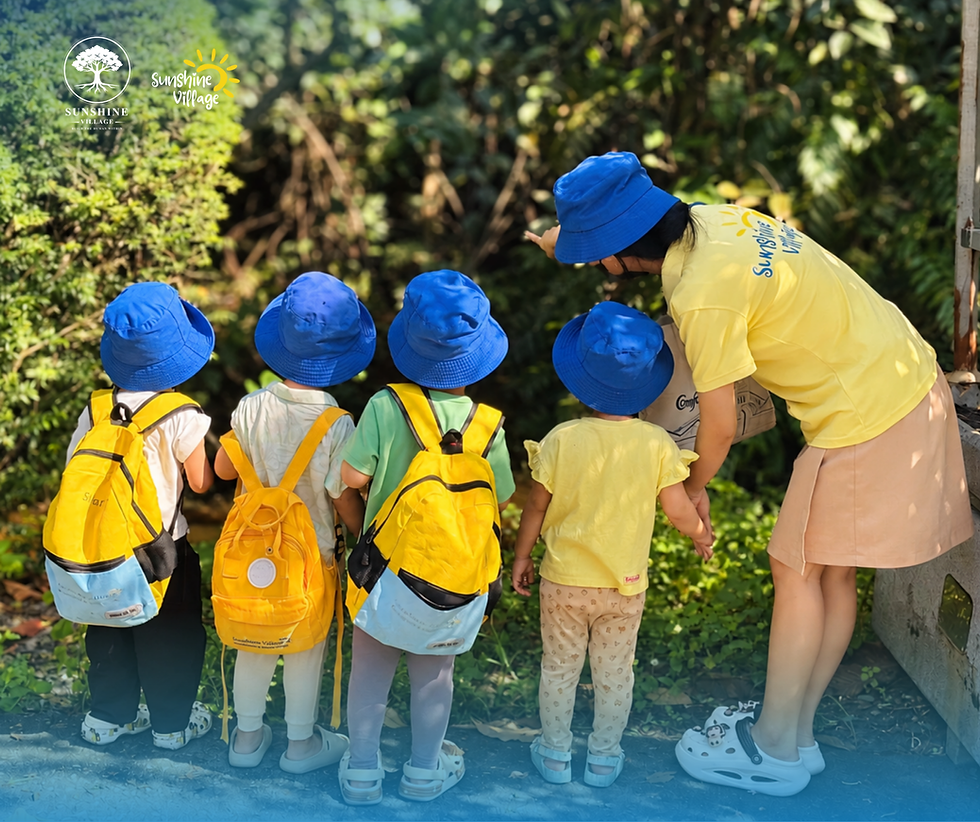
What Is Forest School, and Why Is It More Than “Learning Outdoors”?
Forest School is an educational approach that gives children regular, repeated experiences in natural settings, with learning shaped by their observations, choices, exploration, and active participation. According to the Forest School Association’s principles, it is a long-term process rather than a single outing. Children spend time in nature regularly, have opportunities to play and make choices, and are guided by adults who observe, support, and help them engage with challenges appropriate to their developmental stage.
The key difference is that nature is more than a “location” for a predetermined lesson. What children encounter in their surroundings, the questions they ask, and the problems that arise as they explore can all become starting points for learning. A Forest School session might begin with something as small as an unusually shaped leaf, signs of an insect’s presence, or a branch that will not stay upright. Each of these discoveries can open up opportunities for children to observe, reason, and experiment.
Forest School for Preschoolers Begins with Experience
At the preschool age, children explore the world primarily through their bodies, senses, and firsthand experiences rather than abstract concepts. When they touch a rough surface, feel damp soil after the rain, hear dry leaves crunch beneath their feet, or watch an ant move, they take in a wealth of information that a picture or an explanation cannot fully replace. More importantly, they have the opportunity to be curious and spend time on what interests them, rather than having to move quickly to another task.
These experiences also allow children to learn at their own pace. One child may immediately want to run over and explore a new area, while another may spend a long time observing a small object before feeling ready to join in. Forest School does not aim for every child to respond in the same way to the same situation. Instead, it creates space for each child to approach challenges based on their current abilities and gradually build on those abilities through repeated experiences.

Nature Helps Children Stay Active and Develop Greater Control of Their Bodies
Natural environments are often less level, uniform, or predictable than many spaces designed for children. When children walk across soft ground, balance on an unfamiliar surface, bend down to examine a small object, or coordinate their hands and eyes to arrange natural materials, their bodies must continually process information and adjust their movements. These physical experiences serve a practical purpose: children move because they want to reach a place, bring an idea to life, or explore something that sparks their curiosity, rather than simply because they have been asked to “practice a skill.”
A systematic review of Forest School for children ages 3–6 reported positive findings in several areas, including motor skills, coordination and balance, connection with nature, and health and well-being. However, the researchers also noted that the available evidence remains limited in both the number of studies and their methodological quality. Forest School should therefore be viewed as a promising educational approach rather than a formula that produces the same outcomes for every child.
Exploring Nature Also Engages Children’s Thinking
Nature continually presents situations that have no single predetermined answer. A group of children trying to build a structure with branches must choose materials, compare sizes, test different placements, assess stability, and adjust their approach when the structure will not stand. Through this experience, children can draw on observation, prediction, problem-solving, and spatial reasoning at the same time, without separating them into individual “lessons.”
The value of this process does not depend on children always producing a finished result. An unsuccessful attempt still gives them information they can use to consider what went wrong and change their approach. When adults resist the urge to take over or immediately provide an answer, children have more opportunities to develop the habit of experimenting, observing results, and making adjustments. Over time, this helps them build a sense that they can actively contribute to solving a problem rather than simply waiting for instructions.

Forest School and StoryEQ in Everyday Moments
In an environment with many choices and shared activities, children interact not only with plants, soil, water, and natural materials, but also continually with those around them. When two children want to use the same item, a group has different ideas, or a child needs someone else’s help, social situations arise naturally. In these moments, StoryEQ does not necessarily need to become a separate “lesson about emotions,” because children already have a real context in which to practice waiting, expressing their needs, listening, and finding solutions together.
Children’s emotions also become especially apparent as they explore. They may feel disappointed when something they have just built falls over, hesitant about a new challenge, impatient while waiting, or proud when they finally accomplish something they once thought was difficult. When adults support children by helping them name their feelings, understand what has happened, and find appropriate ways to respond, these experiences become opportunities for children to better understand themselves, rather than simply receiving vague instructions such as “don’t be sad” or “try harder.”
Freedom to Explore Goes Hand in Hand with Adult Support
A common misconception is that a child-centered approach means adults step aside and leave children to manage on their own. In practice, Forest School emphasizes the practitioner’s role in observing, preparing the environment, managing risks, building relationships, and supporting children when needed. Giving children opportunities to make choices or take on challenges always involves assessing whether those experiences are appropriate and ensuring that adults can provide timely support.
The difference lies in how that support is offered. Instead of immediately providing a solution, teachers may spend more time observing, ask a question that encourages children to think, or offer just enough help for them to continue on their own. Once a child is ready to take the next step, the adult steps back again, allowing the child to take the lead. This approach keeps the experience in the child’s hands while ensuring that the environment remains safe and supports meaningful learning.

Forest School for Preschoolers and the Journey of Developing Body, Heart, and Mind
When viewed through the lens of holistic development, the three elements of Body, Heart, and Mind do not exist in isolation. Children use their bodies to explore their surroundings, their thinking skills to understand and solve problems, and experience a range of emotions and social interactions throughout the process. A seemingly simple activity can therefore engage multiple areas of development at once, without turning children’s experiences into a series of disconnected exercises.
For example, when children build a structure together using branches, their bodies are active as they select and arrange materials, their minds are engaged as they observe and figure out how to make the structure stand, and emotions may arise when their first idea fails or when they accomplish what they set out to do. When another child joins in, they also need to learn to communicate, wait, share materials, and work through differences in their ideas. A simple experience can therefore support several aspects of children’s development at the same time.
This is also why the value of Forest School does not necessarily lie in its most “impressive” moments. Many changes grow out of small, repeated experiences: a child feeling brave enough to take one more step, learning to wait for a friend, expressing frustration, or changing their approach when an initial idea does not work. As these real experiences accumulate over time, children have more opportunities to understand their bodies and emotions and gradually develop their own ways of engaging with the world.
Forest School for preschoolers at Sunshine Village is therefore part of a broader journey of nurturing Body, Heart, and Mind. Parents can learn more about the program or visit Sunshine Village to observe the learning environment, speak with the education team, and better understand how Forest School, StoryEQ, and everyday experiences connect as children grow.



Comments